What Is ATHE and How Are ATHE Assignments Assessed?
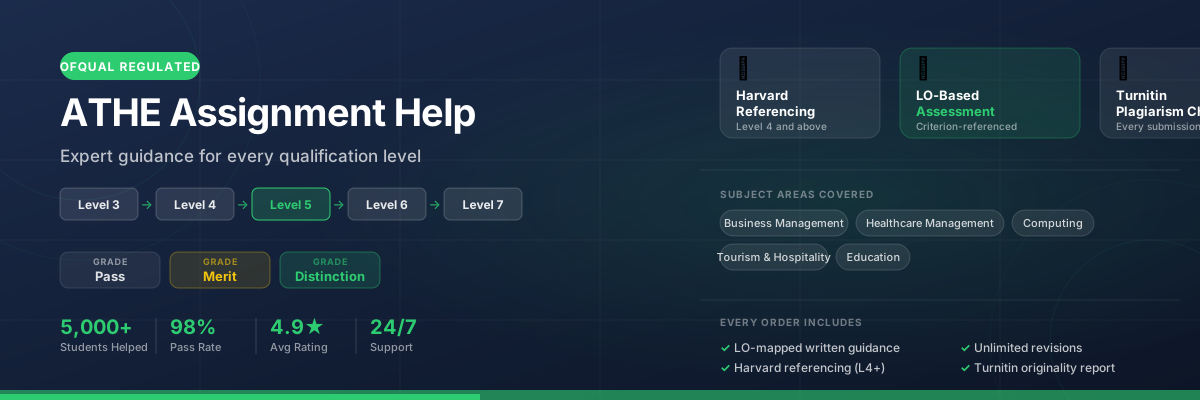
ATHE (Awards for Training and Higher Education) is an Ofqual-regulated UK awarding body offering Level 3 to Level 7 vocational qualifications. Ofqual — the Office of Qualifications and Examinations Regulation — is the government body that regulates qualifications in England. ATHE qualifications sit on the Regulated Qualifications Framework (RQF) and carry formal recognition for employment and higher education progression purposes.
All ATHE assessment is conducted by written coursework submitted to a tutor or assessor at a registered ATHE centre. There are no written examinations at any qualification level. Each unit within an ATHE qualification has a defined set of learning outcomes (LOs) specified in the unit specification. The centre's assessor issues an assignment brief built around these LOs, and the student's written response is marked against each LO individually.
The grading system is criterion-referenced, which means the assessor is not comparing students against each other — they are checking whether the submitted work meets the defined criteria for each grade band. The three grade bands are:
- Pass: All learning outcomes addressed with sufficient evidence. The response covers the required knowledge and understanding at the level specified. Every LO must be addressed — a gap in LO coverage prevents a Pass regardless of the quality of the sections that are present.
- Merit: All LOs met plus merit descriptors satisfied. Merit descriptors typically require analytical writing that examines causes, effects, and relationships; a coherent argument that connects evidence to conclusions; and engagement with wider reading beyond core module texts.
- Distinction: All LOs met plus distinction descriptors satisfied. Distinction descriptors require critical evaluation of competing perspectives or models, synthesis of multiple sources into a unified argument, and professional recommendations explicitly supported by evidence.
ATHE qualifications are internally assessed by the centre and externally moderated by ATHE through External Quality Advisers (EQAs). This external moderation means that grade standards are applied consistently across all registered centres. Qualifications offered include: Level 3 Extended Diploma, Level 4 Diploma, Level 5 Extended Diploma, Level 6 Diploma, and Level 7 Diploma.
ATHE Qualification Levels: From Level 3 to Level 7
ATHE qualifications span five levels of the Regulated Qualifications Framework, each with a distinct degree equivalency, credit volume, subject range, and target student profile. Understanding what each level represents academically is essential for students who are structuring their written work — the expected depth of analysis, the referencing standard, and the complexity of recommendations all increase with each level.
Level 3 Extended Diploma sits at RQF Level 3 and is equivalent to A-levels for UCAS tariff purposes. It is the entry point to the ATHE qualification pathway and is available in Business Management, Healthcare (Health and Social Care), and Tourism and Hospitality. Typical students: school leavers, adult returners, and career starters completing formal academic writing for the first time.
Level 4 Diploma sits at RQF Level 4 and is equivalent to the first year of an undergraduate degree — a Certificate of Higher Education (CertHE) equivalent. Available subjects at Level 4 include Business Management, Healthcare Management, Computing, and Tourism and Hospitality. Harvard referencing is required from Level 4 onwards.
Level 5 Extended Diploma sits at RQF Level 5 and is equivalent to the second year of an undergraduate degree — a Diploma of Higher Education (DipHE) equivalent. This is the most widely studied ATHE level due to its role as the primary qualification for degree top-up progression — UK universities commonly accept Level 5 for entry into the final year of a bachelor's degree.
Level 6 Diploma sits at RQF Level 6 and is equivalent in academic level to a full bachelor's degree. Available in Business Management and Healthcare Management. The Level 6 qualification includes a research project as a key assessment component. Typical students: employer-funded experienced professionals, mid-to-senior career managers, and NHS administrators.
Level 7 Diploma sits at RQF Level 7 and is postgraduate-equivalent for continuing professional development purposes. Available in Strategic Management and Healthcare Management. Distinction requires postgraduate-standard critical evaluation, synthesis, and strategic recommendations. Typical students: NHS managers, HR directors, operations managers, and senior healthcare staff undertaking employer-funded professional development.
How ATHE Assignment Help Addresses Learning Outcomes
Every ATHE unit assignment is structured around a defined set of learning outcomes (LOs) stated in the unit specification. The assessor's marking is organised by these LOs — the written response must address each one individually, with sufficient evidence and argument for the target grade. A response that covers the correct subject matter but does not explicitly map to the LOs will not receive the grade its content quality might otherwise warrant.
This is the most common structural failure in ATHE assignments: students produce well-researched, clearly written work that is broadly relevant to the topic but does not demonstrate direct LO coverage. The assessor cannot credit what is not evidenced against the stated outcome.
Merit and Distinction are not achieved by writing more — they require meeting specific qualitative descriptors beyond the learning outcomes themselves. The service helps students by:
- Identifying which LOs correspond to which assignment task within the brief
- Structuring the written response to address each LO completely, with evidence explicitly connected to the outcome
- Applying the correct level of analysis and critical evaluation to reach the Merit or Distinction threshold for the specific qualification level
- Avoiding the most common failure modes: missing an LO entirely, addressing an LO superficially with description when analysis is required, confusing descriptive writing with the analytical writing required for Merit
Harvard referencing is required at Level 4 and above. The author-date method is used: in-text citations in (Author, Year) format with a complete, alphabetically ordered reference list. At Level 5 and above, the range and quality of academic sources cited is directly relevant to Distinction grading — assessors expect independent engagement with peer-reviewed journals and academic literature, not only core module textbooks.
ATHE Assignment Help by Subject Area
ATHE qualifications cover five primary subject areas. Each subject has distinct assignment formats, analytical frameworks, and depth requirements — and the same criterion-referenced grading system applies across all of them.
Business Management is available from Level 3 to Level 7. At Level 3 and 4, common analytical frameworks include PESTLE analysis, SWOT analysis, and the 4Ps marketing mix. At Level 5, frameworks such as Porter's Competitive Strategy, the Resource-Based View, and the McKinsey 7S Model are applied and critically evaluated. At Level 6 and 7, critical evaluation of strategic management models — Porter, Mintzberg, Ansoff, Kotter — is expected, with professional strategic recommendations contextualised to specific organisational scenarios.
Healthcare Management is available from Level 4 to Level 7. At Level 4, foundational NHS context and healthcare service management principles are applied. At Level 5 and 6, clinical governance frameworks, quality improvement models, and NHS policy documents are integrated. At Level 7, current NHS policy documents — including the NHS Long Term Plan (2019) and NHS People Plan (2020/21) — and leadership frameworks such as the NHS Healthcare Leadership Model are assessed with Distinction-level critical evaluation.
Computing is available at Level 3 to Level 5. Assignment formats are technically structured — systems analysis documents, project plans, technical reports, and security or infrastructure documentation. Evidence-based technical reasoning is the primary assessment requirement.
Tourism and Hospitality is available at Level 3 to Level 5. Assignment formats include market analysis reports, operational management case studies, and destination management analysis. Industry-contextualised evidence — drawing on UNWTO data, VisitBritain statistics, and specific destination or hospitality scenarios — is expected across levels.
Education is available at Level 4 and Level 5. Assignment formats include reflective practice accounts, curriculum design analysis, and professional development reports. Reflective models — Gibbs' Reflective Cycle, Kolb's Experiential Learning — are commonly applied alongside analytical frameworks for curriculum design and learning theory.
Merit and Distinction in ATHE Assignments: What the Criteria Actually Require
The difference between Pass, Merit, and Distinction in ATHE assignments is not a matter of length or effort — it is a matter of the type of thinking demonstrated in the written response. Each grade band has defined descriptors that the assessor applies, and understanding what those descriptors require is the most important factor in achieving the target grade.
Pass-level writing addresses each learning outcome with sufficient knowledge and evidence. It is descriptive and factual — the student demonstrates that they understand the topic, can identify relevant information, and can communicate that understanding clearly. Pass-level work that misses one LO fails regardless of its other quality.
Merit-level writing goes beyond description. It analyses causes, effects, and relationships. It builds a coherent argument that connects evidence to conclusions rather than presenting information sequentially. The key distinction from Pass: a Merit response does not just describe what something is — it explains why it works as it does, how different factors interact, and what the evidence suggests about a specific scenario or context.
Distinction-level writing critically evaluates competing perspectives. It does not simply apply a theory — it interrogates its limitations, compares it to alternative frameworks, and makes a judgement about its applicability in the specific context. It synthesises multiple sources into a unified argument and makes professional recommendations that are specific, evidence-based, and feasible.
A practical distinction: "describe" = Pass; "analyse why" = Merit; "critically evaluate and recommend" = Distinction. This applies across all ATHE qualification levels, with the analytical depth of each grade band increasing progressively from Level 3 through Level 7.
Common errors that prevent Merit or Distinction: starting every response with a definition (Pass-level); not connecting evidence to the specific LO; missing recommendations in tasks that explicitly require them; relying only on core textbooks when journals and policy documents are expected at Level 5 and above.
Who Uses ATHE Assignment Help?
ATHE qualifications are studied by a specific range of learner profiles, each facing distinct challenges when it comes to written assignment completion.
International students — particularly those from West African and South Asian communities — study ATHE qualifications in the UK or via distance learning through registered centres. Many are completing formal UK academic writing for the first time and are unfamiliar with criterion-referenced LO-based assessment, Harvard referencing requirements, or the analytical register expected for Merit and Distinction.
Distance learners study without regular face-to-face tutor contact. Limited access to feedback before submission means structural errors — missed LOs, incorrect referencing, insufficient analytical depth — often go undetected until the assignment is marked.
Career changers at Level 4 and 5 are transitioning from employment into formal academic qualifications. They may have strong subject knowledge but have not written structured academic assignments before. Understanding what a business report format requires at Level 4, or what independent critical evaluation means at Level 5, is not straightforward without specific guidance.
Employer-sponsored professionals at Level 6 are continuing professional development while working full-time. Time constraints are significant, and the stakes per assignment are high. These students need research project support as well as unit assignment guidance.
Senior professionals at Level 7 — NHS managers, HR directors, senior business managers — are completing postgraduate-equivalent qualifications that require strategic analysis, synthesis of academic and professional literature, and evidence-based strategic recommendations.
Which ATHE level are you studying, and what grade are you targeting? The level-specific pages below cover the exact grading criteria, assignment types, subject frameworks, and referencing requirements for each qualification level — from Level 3 Extended Diploma through to Level 7 Diploma. Select your level to get the guidance that applies to your specific qualification.
ATHE Qualification Progression Routes
ATHE qualifications are designed as a progression framework from Level 3 through to Level 7. Students who complete one level can progress to the next, with each transition requiring an increase in the analytical depth and academic standard of written work.
The most common progression routes are: Level 3 Extended Diploma → Level 4 Diploma (the most critical analytical step-up in the entire framework, from descriptive to analytical writing); Level 4 Diploma → Level 5 Extended Diploma (from analysis of taught theory to independent critical evaluation); Level 5 Extended Diploma → degree top-up at a UK university (the most widely used ATHE progression route — many post-92 universities accept Level 5 for entry into the final year of a bachelor's degree); Level 5 or 6 → Level 7 Diploma (for professionals targeting postgraduate-equivalent standing in Strategic or Healthcare Management).
Select your level for dedicated assignment guidance:
ATHE Assignment Types and Referencing Requirements
ATHE assignments take several structural forms depending on the subject, unit, and level. The most common are written business reports, case study analyses, reflective accounts, essays, and research projects. Each has a distinct structural format — a business report requires a structured layout with headed sections addressing each LO; a reflective account applies a reflective model such as Gibbs' Reflective Cycle to a professional or academic experience; a research project (at Level 6) requires a methodology section, data collection, analysis, and conclusions.
Harvard referencing is required at Level 4 and above. The author-date format places citations within the text as (Author, Year) and collects all cited sources in an alphabetically ordered reference list at the end of the document. For direct quotations, a page number is added: (Author, Year, p.XX). At Level 4, the primary requirement is formatting accuracy and consistency. At Level 5 and above, the range and quality of sources — peer-reviewed journals, government publications, industry reports — is assessed alongside formatting accuracy.
Frequently Asked Questions
What is ATHE and who awards ATHE qualifications?
ATHE — Awards for Training and Higher Education — is an Ofqual-regulated UK awarding organisation. ATHE awards vocational qualifications from Level 3 to Level 7 in subjects including Business Management, Healthcare Management, Computing, Tourism and Hospitality, and Education. All ATHE qualifications are assessed by coursework only — no written exams are required at any level.
How are ATHE assignments graded?
ATHE assignments are graded using a criterion-referenced system with three bands: Pass, Merit, and Distinction. Pass requires all learning outcomes to be fully addressed. Merit requires the learning outcomes to be met plus merit descriptors — typically analytical writing and coherent argumentation. Distinction requires the learning outcomes to be met plus distinction descriptors, including critical evaluation, synthesis of sources, and evidence-based professional recommendations.
Which ATHE qualification levels does your assignment help service cover?
Assignment help is available for all ATHE qualification levels: Level 3 Extended Diploma, Level 4 Diploma, Level 5 Extended Diploma, Level 6 Diploma, and Level 7 Diploma. Each level requires a different depth of academic writing — from structured reports at Level 3 to critical strategic analysis at Level 7.
Is Harvard referencing required for ATHE assignments?
Harvard referencing is required for ATHE assignments at Level 4 and above. From Level 4 onwards, correctly formatted Harvard in-text citations and a full reference list are expected in all written assignments. At Level 5 and above, the quality and range of sources also contributes to Merit and Distinction grading.
Need expert help with your ATHE assignment?
Get Help NowCommon Questions
Is this service specific to ATHE qualifications?
Yes. We specialise exclusively in ATHE (Awards for Training and Higher Education) qualifications. Our writers are selected for their specific knowledge of ATHE units, marking criteria, and grade descriptors — not generic academic writing.
Will my assignment be plagiarism free?
Every assignment is written from scratch and run through Turnitin before delivery. You receive a copy of the originality report alongside your completed work.
How quickly can you complete my assignment?
Standard turnaround is 5–7 days. For urgent orders we offer 24-hour and 48-hour expedited delivery at an additional cost. Contact us to confirm availability for your deadline.
What if I'm not happy with the work?
We offer unlimited free revisions within 14 days of delivery. If we cannot meet your requirements after multiple revisions, we offer a full refund — no questions asked.