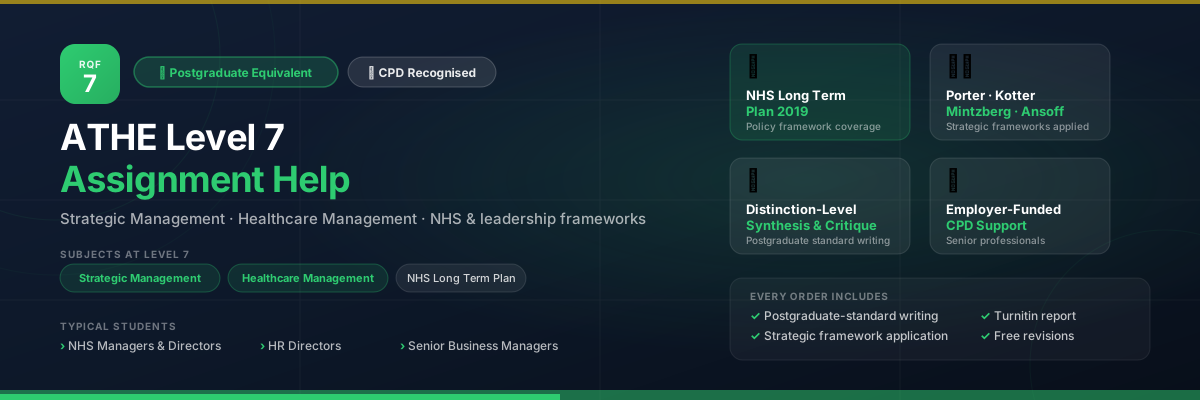
What Is the ATHE Level 7 Diploma and Who Is It For?
ATHE (Awards for Training and Higher Education) is an Ofqual-regulated UK awarding body. Level 7 sits at the top of the Regulated Qualifications Framework (RQF) and is recognised as postgraduate-equivalent for continuing professional development purposes. Two diploma routes are available: Strategic Management and Healthcare Management. Both are assessed entirely by written assignments — no examinations at any point in the qualification.
Typical learner: a senior professional with 5 or more years of industry experience. NHS managers, HR directors, operations managers, department heads, and clinical leads are the most common Level 7 student profiles. Most are employer-funded — the qualification is used as a formal CPD credential within corporate management development programmes and NHS workforce development frameworks.
The qualification does not carry the same FHEQ recognition as an academic Masters degree — it is not equivalent to a university Master's for the purposes of further academic study. However, the analytical depth, referencing standard, and theoretical engagement required of written assignments mirrors postgraduate academic work. "Postgraduate-equivalent" means the academic standard of the work required — not the formal university credential conferred.
How Are ATHE Level 7 Assignments Assessed?
All assessment at Level 7 is coursework only. Each unit has a set of learning outcomes (LOs) defined in the unit specification. Every assignment brief issued by the centre is built around these LOs — the written response must address each one directly and with sufficient evidence. A response that is broadly relevant but does not map explicitly to the LO structure will not meet Pass threshold, regardless of the quality of the prose.
Typical unit assignment length: 3,000 to 5,000 words per unit, depending on the unit and the centre. Word count guidance varies by centre — learners must confirm their centre's specific requirements before structuring the response. Submissions go to a registered ATHE centre assessor. Work is internally moderated and subject to ATHE external quality assurance.
Strategic Management route units: Strategic Leadership, Leading Organisational Change, Strategic HRM, Managing the Strategic Planning Process. Healthcare Management route units: Advanced Healthcare Management, Strategic Leadership in Health and Social Care, Managing People in Health and Social Care, Healthcare Policy and the NHS.
ATHE Level 7 Grading Criteria: Pass, Merit, and Distinction Explained
Pass: All learning outcomes are addressed with correct subject knowledge applied and evidence referenced. Description and explanation at an appropriate postgraduate-equivalent level, with no significant gaps in LO coverage. Pass is the minimum standard — it requires correctly structured, referenced responses to each stated LO.
Merit: All LOs met plus Merit descriptors. At Level 7, Merit requires a coherent and sustained argument across the entire assignment — not just in selected sections. The argument must consistently apply relevant management or healthcare theory to specific organisational or policy contexts, with analytical reasoning supported by properly cited academic and professional sources.
Distinction: All LOs and Merit descriptors met plus Distinction descriptors. At Level 7, Distinction requires: (1) Critical evaluation — not just applying a framework but assessing its limitations, comparing it to competing frameworks, and justifying which is most appropriate in the specific context; (2) Synthesis — drawing conclusions that integrate evidence from multiple academic and professional sources; (3) Professional strategic recommendations — specific, justified, and feasible recommendations demonstrating applied professional judgement; (4) Evaluative depth — showing awareness of the complexity of real-world strategic or healthcare management decisions.
Concrete example for a Strategic Leadership unit: A Pass response describes Bass's (1985) transformational leadership model. A Merit response applies it to a named organisational change scenario, connecting transformational leadership behaviours to specific performance outcomes. A Distinction response critically evaluates Bass (1985) against Burns's (1978) original transactional/transformational framework, assesses the appropriateness of transformational leadership in the specific context, integrates evidence from peer-reviewed journals, and makes a specific recommendation with justification grounded in the organisational context.
ATHE Level 7 Strategic Management Assignments: Frameworks and Theory Required
Strategic Leadership: Bass's transformational leadership model (1985) and Burns's earlier transactional/transformational distinction (1978) are central. Goleman's emotional intelligence dimensions (1995) are frequently relevant — self-awareness, self-regulation, motivation, empathy, and social skill as leadership competencies. Servant leadership (Greenleaf, 1970) provides a contrasting model for critical comparison. Distinction responses compare these frameworks directly and evaluate their applicability to the specific scenario.
Leading Organisational Change: Kotter's 8-Step Change Model (1996) — the eight stages from creating urgency through to instituting change permanently. Lewin's Three-Stage Model (1951) — Unfreeze, Change, Refreeze — simpler but analytically useful for comparative evaluation of its limitations (linear, planned change assumptions). McKinsey 7S Framework for assessing organisational readiness for change. Distinction responses evaluate the assumptions embedded in each model and consider which is most applicable to the specific organisational type and change context.
Strategic Management: Porter's Generic Strategies (1980) — Cost Leadership, Differentiation, and Focus. At Level 7, PESTLE analysis means identifying which macro-environmental factors create strategic risk or opportunity and deriving strategic responses — not listing factors. SWOT analysis must connect internal capabilities to external opportunities and threats and derive strategic choices. Distinction: evaluate the limitations of Porter's generic strategies framework and compare with the Resource-Based View (Barney, 1991) as an alternative strategic logic.
Strategic HRM: Ulrich's HR Business Partner model (1997) — four HR roles: Strategic Partner, Change Agent, Administrative Expert, and Employee Champion. The Resource-Based View of the firm (Barney, 1991) — competitive advantage from internal VRIN resources (Valuable, Rare, Inimitable, Non-substitutable). Distinction: connect HR strategy explicitly to organisational strategy and evaluate whether Ulrich's model is applicable to the specific organisation type described.
ATHE Level 7 Healthcare Management Assignments: NHS Context and Policy Frameworks
Advanced Healthcare Management: The NHS Long Term Plan (NHS England, 2019) is the primary strategic document — its five-year commitments cover prevention and health inequality, primary care network expansion, mental health services, cancer and cardiovascular treatment, and digital transformation. Distinction responses engage with the Long Term Plan critically — what has been achieved, what has stalled, and what the implications are for a specific management scenario.
NHS People Plan (NHS England, 2020/21): Covers workforce strategy across four themes — looking after our people, belonging in the NHS (diversity and inclusion), new ways of working and delivering care, and growing for the future (recruitment and retention). Level 7 Healthcare Management assignments frequently require analysis of workforce planning implications — shortage data from NHS Digital, international recruitment context, and retention strategy.
Integrated Care Systems (ICSs): Established formally under the Health and Care Act 2022, ICSs replaced Clinical Commissioning Groups (CCGs) and bring NHS trusts, local authorities, and primary care networks into a single governance and commissioning structure. Healthcare Management assignments at Level 7 frequently require analysis of ICS governance implications.
Clinical governance: Scally and Donaldson's (1998) clinical governance framework — seven pillars: clinical effectiveness, risk management, patient and public involvement, clinical audit, research and development, education and training, and use of information. CQC Well-Led Framework as the current regulatory quality assessment tool. NHS Patient Safety Strategy (2019) and duty of candour regulations. Distinction responses connect policy to operational implications with specific professional recommendations.
Harvard Referencing for ATHE Level 7 Assignments
Harvard referencing uses author-date in-text citations: (Bass, 1985) or Bass (1985) depending on sentence structure. The reference list is alphabetical by author surname. For direct quotations: (Bass, 1985, p. 23). Direct quotations should be used sparingly at Level 7 — paraphrasing and synthesis are expected. A Distinction-level assignment that reads as a series of block quotations has not demonstrated synthesis.
Source quality at Level 7: peer-reviewed academic journals are expected alongside textbooks. Key journals for Strategic Management: Journal of Management, Harvard Business Review, Strategic Management Journal, Academy of Management Review. For Healthcare Management: BMJ, Health Policy, Journal of Health Services Research and Policy, plus NHS England and NHS Digital official publications as primary policy sources.
Common referencing errors at Level 7: citing only textbooks (insufficient for Distinction); citing websites without author or date; citing "NHS" as an author without identifying the specific publication and year; failing to include page numbers for direct quotations.
How Our ATHE Level 7 Assignment Help Service Works
Level 7 students do not need general writing help — they need strategic-analysis-level academic writing support with precise knowledge of ATHE's grading descriptors and unit learning outcomes. Both diploma routes are covered explicitly: Strategic Management writers have working familiarity with Bass, Kotter, Porter, Ulrich, Barney, Lewin, and Goleman. Healthcare Management writers understand NHS policy context, clinical governance frameworks, the Healthcare Leadership Model, and Integrated Care Systems.
Learning outcome mapping: every assignment produced is structured to address each specified LO directly and explicitly. This is the single most common reason Level 7 assignments fall below the Pass threshold — LOs are not addressed systematically, even when the subject knowledge is present. Harvard referencing is applied throughout: in-text citations, reference list construction, and source selection guidance for the specific unit topic.
Process: share the assignment brief and unit specification via the contact form → the service produces a structured response meeting all LOs at the requested grade level (Pass, Merit, or Distinction) → Harvard referencing applied throughout at Level 7 academic source standard.
What does earning a Distinction in an ATHE Level 7 assignment actually require — and how does postgraduate-standard writing differ from what most professionals have produced before? The supplementary sections below address progression context from Level 5 and the comparison with ILM and CMI Level 7 qualifications that many professionals research when choosing between qualification routes.
ATHE Level 7 and Progression: From Level 5 and Beyond
Many ATHE Level 7 learners enter with an ATHE Level 5 qualification or equivalent Level 5 credential. Level 5 focuses on operational management, applied theory, and process-level analysis — critical evaluation of individual frameworks and independent source engagement. Level 7 requires a shift in analytical register: from operational application to strategic synthesis and evaluation, from analysing how a framework applies to interrogating whether it should be applied and what should be recommended instead.
For professionals who enter Level 7 via a professional experience route without a prior ATHE Level 5 qualification, the analytical standard required does not change — the assignments are marked against the same grading descriptors regardless of entry route.
For overview context: ATHE assignment help. For Level 6 guidance: ATHE Level 6 assignment help.
How ATHE Level 7 Compares to ILM Level 7 and CMI Level 7
ATHE Level 7, ILM Level 7 (Institute of Leadership and Management), and CMI Level 7 (Chartered Management Institute) all sit at RQF Level 7 and are postgraduate-equivalent for CPD purposes. Key differences: ILM and CMI qualifications are more widely recognised in the corporate management sector, with longer histories and larger membership bases. ATHE Level 7 has stronger presence in the healthcare management and further education sectors, particularly among NHS-funded learners. Assessment format differs: ILM and CMI pathways may include reflective portfolios and work-based projects alongside written assignments; ATHE Level 7 is written coursework only throughout.
Return to overview: ATHE assignment help.
Frequently Asked Questions
What is the difference between a Merit and a Distinction in an ATHE Level 7 assignment?
Merit requires all learning outcomes to be met alongside a coherent and sustained argument with consistent application of relevant management or healthcare theory to a specific organisational context, supported by properly referenced academic sources. Distinction requires all Merit criteria plus critical evaluation of competing theoretical frameworks, synthesis of evidence from multiple academic and professional sources, and professional strategic recommendations with clear justification — demonstrating postgraduate-level evaluative depth throughout the assignment.
Does ATHE Level 7 require peer-reviewed journal sources?
Distinction-level ATHE Level 7 assignments require peer-reviewed journal articles alongside textbooks. Government policy documents — such as NHS England publications and CIPD reports — are also accepted primary sources for relevant topics. Assignments that rely solely on textbook citations are unlikely to meet Distinction descriptors for source quality. Key journals for Strategic Management include the Strategic Management Journal and Harvard Business Review; for Healthcare Management, the BMJ and Journal of Health Services Research and Policy are appropriate.
What theoretical frameworks are most commonly assessed in ATHE Level 7 Strategic Management assignments?
Strategic Management route assignments most frequently assess Bass's (1985) transformational leadership model, Kotter's (1996) 8-Step Change Model, Lewin's (1951) Three-Stage Change Model, Porter's (1980) Generic Strategies, the Ulrich (1997) HR Business Partner model, and Barney's (1991) Resource-Based View. Distinction-level responses require critical evaluation of these frameworks — assessing their limitations and comparing them to alternative models.
Can ATHE Level 7 be studied without having completed Level 5 first?
Entry to ATHE Level 7 is possible via a professional experience route — a prior ATHE Level 5 qualification is not a mandatory requirement for all centres. Centres assess individual learner suitability based on professional background, experience, and prior academic or vocational achievement. Regardless of entry route, the analytical standard required for Level 7 assignments remains the same: postgraduate-equivalent critical evaluation, synthesis, and strategic recommendation at every grade above Pass.
Need expert help with your ATHE assignment?
Get Help NowCommon Questions
Is this service specific to ATHE qualifications?
Yes. We specialise exclusively in ATHE (Awards for Training and Higher Education) qualifications. Our writers are selected for their specific knowledge of ATHE units, marking criteria, and grade descriptors — not generic academic writing.
Will my assignment be plagiarism free?
Every assignment is written from scratch and run through Turnitin before delivery. You receive a copy of the originality report alongside your completed work.
How quickly can you complete my assignment?
Standard turnaround is 5–7 days. For urgent orders we offer 24-hour and 48-hour expedited delivery at an additional cost. Contact us to confirm availability for your deadline.
What if I'm not happy with the work?
We offer unlimited free revisions within 14 days of delivery. If we cannot meet your requirements after multiple revisions, we offer a full refund — no questions asked.