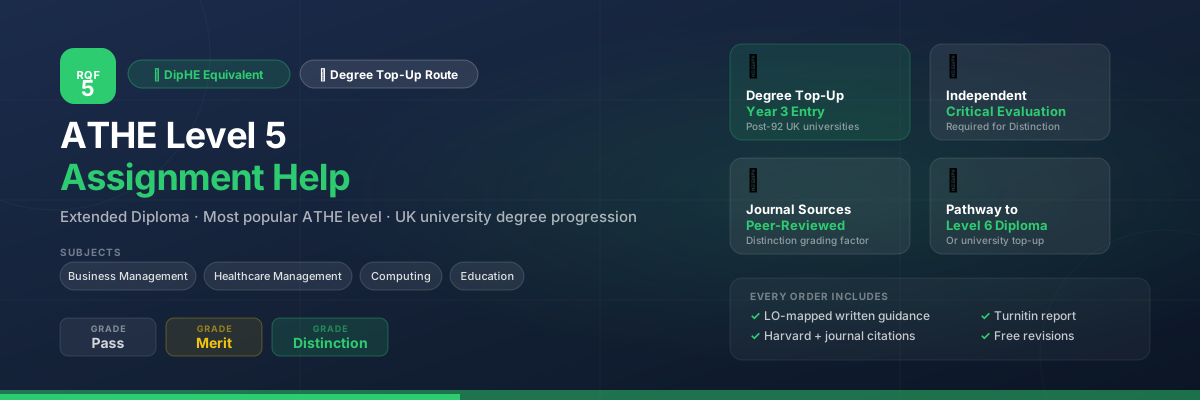
What Is the ATHE Level 5 Extended Diploma?
ATHE Level 5 Extended Diploma is a qualification at RQF Level 5 awarded by ATHE, an Ofqual-regulated UK awarding body. It is equivalent to the second year of an undergraduate degree — a Diploma of Higher Education (DipHE equivalent). Assessment is entirely coursework-based: written assignments submitted to a tutor or assessor at a registered ATHE centre, with no written exams at any point.
The Level 5 Extended Diploma is the most popular ATHE qualification for progression to a degree top-up — UK universities commonly accept Level 5 as the basis for entry into the final year of a bachelor's degree. This makes Level 5 assignment performance consequential beyond the qualification itself: Merit and Distinction grades at Level 5 are the most direct evidence a student can present of readiness for final-year degree-level academic work.
Available subjects: Business Management, Healthcare Management, Computing, and Tourism and Hospitality — continuation of Level 4 subject streams. Grading uses the same criterion-referenced Pass/Merit/Distinction structure as Level 4, but with substantially higher analytical expectations at both Merit and Distinction, particularly in terms of independent research and source engagement.
How ATHE Level 5 Assignments Differ from Level 4
Level 4 assignments typically require application of theories and frameworks to scenarios with referenced support — analysis is required but grounded primarily in taught module content. Level 5 assignments require independent identification and critical evaluation of academic literature beyond recommended reading lists. Students must select, appraise, and synthesise sources independently — the reading list is a starting point, not the scope of expected engagement.
At Level 5, Distinction requires synthesis — integrating insights from multiple sources into a coherent, original argument rather than sequentially presenting evidence from different authors. This is a qualitative shift from Level 4 Distinction, which requires critical evaluation of taught frameworks. At Level 5, the student must demonstrate that they have formed an independent analytical position.
Critical evaluation at Level 5 means examining the limitations, assumptions, and applicability of theories — not just applying them to a case. A Level 5 Distinction response does not describe a theory and then apply it; it interrogates whether the theory is adequate for the specific context, considers alternative frameworks, and synthesises a position. Professional recommendations at Distinction level must be evidenced, specific, and contextualised to the assignment scenario.
ATHE Level 5 Grading Criteria: Pass, Merit, and Distinction
Pass: All learning outcomes met with adequate evidence — descriptive coverage of required content. The response addresses each LO with sufficient knowledge and coherent presentation. Pass at Level 5 requires the same LO-mapping discipline as lower levels: no LO may be omitted.
Merit: LOs met plus merit descriptors — analytical writing examining relationships and mechanisms; coherent argument supported by a range of referenced academic sources; engagement with literature beyond core module texts. Merit at Level 5 means the student has independently engaged with the academic literature relevant to the task and built an argument from it — not just summarised what the module taught.
Distinction: LOs met plus distinction descriptors — independent critical evaluation of competing theories and models; synthesis of multiple sources into a unified argument; specific, evidence-based professional recommendations appropriate to the assignment context. The Level 5 distinction bar requires students to demonstrate independent academic judgement — interrogating the limitations of taught frameworks and forming a synthesised position.
Example in Healthcare Management (managing healthcare services unit): Pass = describes management approaches used in NHS settings. Merit = analyses the effectiveness of different approaches with evidence from academic sources, connecting management theory to NHS operational context. Distinction = critically evaluates competing management theories, identifies limitations of each in the NHS context, synthesises evidence from policy documents and peer-reviewed journals, and recommends a contextually appropriate approach for a specific healthcare setting with evidence-based justification.
ATHE Level 5 Subjects and Assignment Types
Business Management at Level 5: Strategic analysis reports, organisational management case studies, and business environment analysis. Common frameworks at Level 5: Porter's Competitive Strategy (Generic Strategies — Cost Leadership, Differentiation, Focus), the Resource-Based View (Barney, 1991 — VRIN resources as the source of sustainable competitive advantage), McKinsey 7S Framework, and the Balanced Scorecard (performance measurement across financial, customer, internal process, and learning/growth perspectives). At Distinction level, students evaluate the assumptions and limitations of these frameworks.
Healthcare Management at Level 5: Healthcare policy analysis, NHS management reports, and quality improvement case studies. Requires integration of clinical governance principles, patient safety frameworks, and managerial theory. At Level 5, students are expected to connect management theory to specific NHS operational contexts and evaluate the applicability of management models to healthcare — a context with distinct structural, regulatory, and ethical constraints.
Computing at Level 5: Advanced systems analysis, project management reports, and security and infrastructure documentation. Evidence-based technical reasoning combined with project management and professional development analysis.
Tourism and Hospitality at Level 5: Destination management reports, hospitality operations strategy analysis, and international tourism policy assessment. Industry-contextualised with global examples — UNWTO data, VisitBritain reports, and specific destination management case studies provide the evidence base for analytical tasks.
Independent Research and Harvard Referencing at ATHE Level 5
Level 5 students are expected to independently identify relevant academic sources — peer-reviewed journal articles, academic textbooks, government policy documents, and professional body publications. The recommended reading list from the module is the starting point; Distinction-level work goes substantially beyond it. Key academic databases accessible for Level 5 research include Google Scholar, JSTOR, and institutional library portals where available.
Harvard referencing at Level 5 is assessed for accuracy, range, and relevance — not just formatting compliance. In-text citations: (Author, Year, p.XX) for direct quotes; (Author, Year) for paraphrased ideas. Reference list: alphabetical by author surname. Distinction-level work at Level 5 typically cites 15–25 sources, with a mix of academic textbooks, peer-reviewed journal articles, and policy or industry documents.
Common referencing errors at Level 5: relying only on core module textbooks (insufficient for Merit or Distinction); citing websites without author attribution; missing page numbers on direct quotations. At Level 5, source selection itself is an indicator of research quality — assessors note whether the sources cited are appropriate, recent, and relevant to the specific task.
ATHE Level 5 and Degree Top-Up Progression
A degree top-up is a one-year (full-time) or two-year (part-time) final year of a bachelor's degree programme at a UK university, entered on the basis of an equivalent Level 5 qualification. ATHE Level 5 Extended Diploma is the most common ATHE qualification used for degree top-up entry. UK universities with progression pathways for ATHE Level 5 students typically include post-92 universities — students should confirm specific entry requirements and any subject alignment requirements with their target institution.
Merit and Distinction grades at Level 5 strengthen degree top-up applications and prepare students for the analytical standard of final-year degree study. The critical evaluation and independent research skills required for Level 5 Distinction are the same skills assessed in final-year degree modules. Students targeting degree progression should prioritise achieving Merit and Distinction at Level 5, not only Pass, as a demonstration of readiness for degree-level independent study.
Which Level 5 subject are you studying, and are you targeting Merit, Distinction, or degree top-up readiness? The supplementary sections below address the transition from Level 4 and the higher education landscape after Level 5 — including the Level 6 route for students who choose to continue within the ATHE framework.
Transitioning from ATHE Level 4 to Level 5
Students entering Level 5 from Level 4 face a step-change in analytical expectations. At Level 4, analysis is grounded in taught content — applying frameworks to scenarios with referenced support. At Level 5, the requirement shifts to independent critical evaluation of competing theories and synthesis across multiple academic sources. Students who struggled to reach Distinction at Level 4 — because their responses were analytical but not yet evaluative — will find Level 5 demands those evaluative skills from the outset, even for Merit.
The most common challenge for Level 4-to-Level 5 transitions: moving from applying a framework (Level 4 Merit) to interrogating its limitations and comparing it to alternative frameworks (Level 5 Merit). Students who relied solely on core module textbooks at Level 4 will need to develop independent source-finding skills before Level 5 assignments are due.
For Level 4 support: ATHE qualification assignment help overview | ATHE Level 4 Diploma assignment guidance.
ATHE Level 5 and Higher Education Entry: What Comes Next
After completing the ATHE Level 5 Extended Diploma, the most common next step is a degree top-up at a UK university. Final-year degree study requires the same independent research, critical evaluation, and synthesis skills that Level 5 Distinction demands — students who have achieved these at Level 5 are academically prepared for degree-level final-year modules.
For students who choose to continue within the ATHE framework rather than entering university immediately, Level 6 Diploma is a degree-level qualification in its own right — at RQF Level 6, it is equivalent to a full bachelor's degree. This route is most common for employer-funded professionals who need a degree-level credential but prefer not to attend university full-time.
For Level 6 guidance: ATHE Level 6 Diploma degree-level assignment support.
Frequently Asked Questions
What is the difference between ATHE Level 4 and Level 5?
ATHE Level 4 is a Diploma equivalent to the first year of an undergraduate degree; Level 5 is an Extended Diploma equivalent to the second year. The primary difference in assignments is the analytical depth required — Level 5 demands independent critical evaluation of academic literature and synthesis of multiple sources, whereas Level 4 requires analysis and argument grounded in taught content. Both are assessed by coursework only with the same Pass/Merit/Distinction grading system.
Can ATHE Level 5 lead to a university degree?
ATHE Level 5 Extended Diploma is the most common ATHE qualification used for progression to a university degree top-up programme. Many UK universities accept Level 5 as the basis for entry into the final year of a bachelor's degree. Strong Merit and Distinction grades at Level 5 support degree top-up applications and prepare students for the analytical standard expected in final-year degree study.
What do ATHE Level 5 Distinction assignments look like?
Distinction assignments at ATHE Level 5 meet all learning outcomes, satisfy merit descriptors, and additionally demonstrate independent critical evaluation of competing theories, synthesis of multiple academic sources into a coherent argument, and specific professional recommendations supported by evidence. The assessor must be able to identify that the student has independently engaged with literature beyond the core reading list and has formed and defended an original academic position.
Is Harvard referencing more important at Level 5 than Level 4?
Harvard referencing is required from Level 4 upwards and is assessed at both levels. At Level 5, the range and quality of academic sources cited is directly relevant to Distinction grading — assessors expect independent engagement with peer-reviewed journals, academic texts, and policy documents. Distinction-level work at Level 5 typically references 15–25 sources across a range of academic source types.
Need expert help with your ATHE assignment?
Get Help NowCommon Questions
Is this service specific to ATHE qualifications?
Yes. We specialise exclusively in ATHE (Awards for Training and Higher Education) qualifications. Our writers are selected for their specific knowledge of ATHE units, marking criteria, and grade descriptors — not generic academic writing.
Will my assignment be plagiarism free?
Every assignment is written from scratch and run through Turnitin before delivery. You receive a copy of the originality report alongside your completed work.
How quickly can you complete my assignment?
Standard turnaround is 5–7 days. For urgent orders we offer 24-hour and 48-hour expedited delivery at an additional cost. Contact us to confirm availability for your deadline.
What if I'm not happy with the work?
We offer unlimited free revisions within 14 days of delivery. If we cannot meet your requirements after multiple revisions, we offer a full refund — no questions asked.