What Is the ATHE Level 4 Diploma?
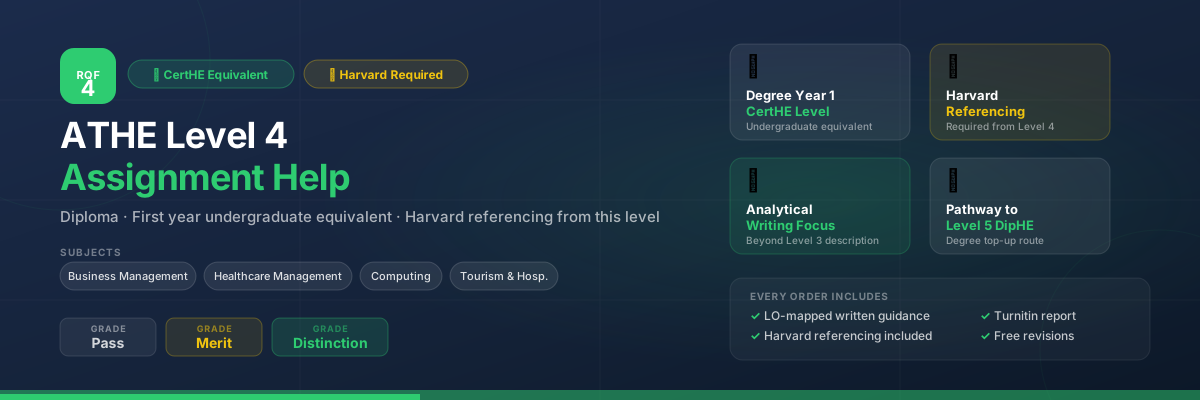
ATHE Level 4 Diploma is awarded by ATHE (Awards for Training and Higher Education), an Ofqual-regulated UK awarding body. It sits at RQF Level 4 — equivalent to the first year of an undergraduate degree (Certificate of Higher Education). This makes Level 4 the entry point to higher education-equivalent academic work within the ATHE framework.
All assessment is written coursework submitted to a tutor or assessor at a registered ATHE centre — no written exams at any point in the qualification. Grading is criterion-referenced: assessors check whether each learning outcome is met and whether merit and distinction descriptors are satisfied, applying consistent standards moderated externally by ATHE.
The Level 4 Diploma is among the most searched ATHE levels — particularly popular with career changers re-qualifying for business or healthcare roles, and with international students studying via UK-approved centres. Available subjects at Level 4: Business Management, Healthcare Management, Computing, and Tourism and Hospitality. Harvard referencing is required from Level 4 onwards — it is introduced at this level and becomes progressively more rigorous at Level 5 and above.
ATHE Level 4 Subjects and Assignment Types
Business Management: Written business reports, case studies, and strategic analysis tasks. Common analytical frameworks at Level 4 include PESTLE analysis (identifying macro-environmental factors and assessing their strategic implications for a named business), SWOT analysis (connecting internal strengths and weaknesses to external opportunities and threats), and stakeholder analysis (mapping stakeholder interests and power in a business decision scenario). Tasks require application of theory to specific business scenarios — not description of frameworks in the abstract.
Healthcare Management: Written reports on healthcare policy and service management, reflective accounts of professional practice, and management of healthcare services assignments. Requires foundational understanding of NHS structure and UK healthcare context. Key frameworks at Level 4: management approaches in healthcare settings, person-centred care principles, and basic quality improvement models.
Computing: Technical reports, systems analysis documents, and project plans. More structured and less discursive than Business Management or Healthcare — evidence-based technical reasoning is the primary assessment requirement. Assignments typically ask learners to analyse a system, propose a solution, or document a technical approach with justified rationale.
Tourism and Hospitality: Market analysis reports, operational case studies, and customer service strategy assignments. Industry-contextualised with real-world scenario application. Common sources at Level 4: UNWTO data, VisitBritain statistics, and hospitality industry benchmarks.
ATHE Level 4 Grading Criteria: Pass, Merit, and Distinction
Pass: All learning outcomes addressed with adequate evidence. Descriptive but complete — factual accuracy and LO coverage are the minimum standard. A response that covers the correct subject matter clearly and correctly, addresses every LO in the brief, and presents relevant evidence meets Pass. Description alone, however well-written, does not exceed Pass.
Merit: All LOs met plus merit descriptors — analysis of causes, effects, and relationships; coherent argumentation connecting evidence to conclusions; engagement with wider reading beyond core module texts. Merit at Level 4 requires the learner to move from describing what something is to explaining how it works, why it matters in a specific context, and what the evidence suggests about the scenario being analysed.
Distinction: All LOs met plus distinction descriptors — critical evaluation of competing perspectives or models; synthesis of multiple sources into a unified argument; professional recommendations explicitly supported by evidence. Distinction at Level 4 requires the learner to interrogate the theories they apply: identify their limitations, compare them to alternative frameworks, and make a specific, evidence-based recommendation.
Practical example for a Business Management unit on organisational culture: Pass = defines culture and lists Handy's (1976) four culture types. Merit = analyses how the culture type present in a specific named organisation affects employee performance. Distinction = critically evaluates competing theories of culture change (Handy vs. Schein), identifies which is most applicable to the specific organisational scenario, and recommends a specific change strategy with evidence-based justification.
Most common reason students miss Merit: addressing LOs descriptively without demonstrating analysis. Most common reason students miss Distinction: meeting Merit descriptors but failing to include specific, evidence-based recommendations.
How to Address ATHE Level 4 Learning Outcomes in Written Assignments
Each ATHE Level 4 unit specification states a set of learning outcomes — typically 3–5 per unit. Each assignment task maps to one or more LOs; some tasks address a single LO and others require addressing multiple LOs in one response. The assignment brief issued by the centre specifies which LOs each task addresses — this document must be read before structuring any response.
Structural approach: identify each LO, plan which part of the response addresses it, and ensure that evidence and argument are explicitly present for each one. A common structural error at Level 4 is writing a long, well-researched general essay without connecting content explicitly to the stated LOs. Assessors mark against the LO structure — they cannot credit content that is present in the response but not evidenced against the specific outcome.
At Pass level, the primary requirement is that each LO is addressed with correct knowledge. At Merit and above, the way in which evidence is used to build an argument around each LO is what separates grade bands. At Level 4, engagement with sources beyond the core module reading list is expected for Merit — and demonstrated critical engagement with those sources is required for Distinction.
Harvard Referencing at ATHE Level 4
Harvard referencing is required in all ATHE assignments at Level 4 and above. The author-date method is used: in-text citations appear as (Author, Year) within the body of the text, and a full reference list — ordered alphabetically by author surname — appears at the end of the document. For direct quotations, a page number is added: (Author, Year, p.XX).
Academic sources expected at Level 4: textbooks relevant to the subject area, peer-reviewed journal articles where accessible, government reports and policy documents, and industry publications. Harvard referencing at Level 4 is not merely a formatting exercise — assessors at Merit and Distinction level expect evidence of engagement with a range of relevant academic sources beyond the core module materials.
Reference list format for a book: Author, Initials. (Year) Title of Book. Place: Publisher. For a journal article: Author, Initials. (Year) 'Title of article', Journal Name, Volume(Issue), pp. XX–XX. Common referencing errors that affect grading: missing in-text citations for ideas taken from sources, a reference list that does not correspond to in-text citations, incorrect date format, and no author attribution for website sources.
Who Studies ATHE Level 4 and What Challenges Do They Face?
Career changers: Transitioning from employment into a formal qualification, often without previous experience of writing academic assignments. Unfamiliarity with LO-based assessment is the most common early challenge. Understanding what "analyse" means in grading terms (as distinct from "describe") is the second most common difficulty.
International students (particularly West African and South Asian communities): studying via UK-approved centres or distance learning. UK academic writing conventions — essay structure, argument development, academic register — may be unfamiliar. Harvard referencing is often a new requirement. The criterion-referenced grading system, where Pass/Merit/Distinction are defined by specific descriptors rather than a percentage mark, requires explicit explanation before the first assignment.
Distance learners: Studying without regular face-to-face tutor interaction, with limited opportunities to receive feedback before submission. Higher risk of structural errors — missed LOs, insufficient analytical depth, incorrect referencing — going undetected until the assignment is marked.
What subject are you studying at ATHE Level 4, and which assignment task are you struggling with? The supplementary section below covers progression to Level 5 and the specific changes in analytical expectations that students need to prepare for as they advance through the ATHE qualification framework.
Progressing from ATHE Level 4 to Level 5
After completing the ATHE Level 4 Diploma, the standard next step is the ATHE Level 5 Extended Diploma — equivalent to the second year of an undergraduate degree (DipHE equivalent). Level 5 requires a higher level of analytical depth, with greater emphasis on independent research and critical evaluation across all written assignments. At Level 4, analysis is grounded in taught content — applying frameworks to scenarios with referenced support. At Level 5, students must independently identify and critically evaluate academic literature beyond recommended reading lists, and demonstrate synthesis across sources.
Strong performance at Level 4 (Merit and Distinction) supports progression and prepares students for Level 5 complexity. The most common ATHE progression route overall is Level 4 → Level 5 → degree top-up at a UK university.
For more information: ATHE qualification assignment help overview | ATHE Level 5 Extended Diploma assignment guidance.
Frequently Asked Questions
What subjects are available at ATHE Level 4?
ATHE Level 4 Diploma subjects include Business Management, Healthcare Management, Computing, and Tourism and Hospitality. Each subject has its own set of units with distinct assignment tasks and learning outcomes, though all are assessed through the same criterion-referenced grading system — Pass, Merit, and Distinction.
What does the ATHE Level 4 Diploma qualify as?
ATHE Level 4 Diploma is a qualification at RQF Level 4, equivalent in academic level to the first year of an undergraduate degree (Certificate of Higher Education). It is awarded by ATHE, an Ofqual-regulated UK awarding organisation, and is assessed entirely by coursework — no written exams are required.
Is Harvard referencing compulsory in ATHE Level 4 assignments?
Harvard referencing is compulsory in all ATHE assignments at Level 4 and above. Students must use the author-date format for in-text citations and provide a correctly formatted reference list at the end of each assignment. The quality and range of academic sources cited also contributes to achieving Merit and Distinction grades.
How is the Merit grade different from Pass at ATHE Level 4?
Merit at ATHE Level 4 requires students to meet all learning outcomes (Pass standard) and also satisfy merit descriptors — which typically require analytical writing that examines causes, effects, and relationships, a coherent argument connecting evidence to conclusions, and engagement with wider academic reading beyond the core module materials. Descriptive writing alone achieves Pass; analysis and argument are required for Merit.
Need expert help with your ATHE assignment?
Get Help NowCommon Questions
Is this service specific to ATHE qualifications?
Yes. We specialise exclusively in ATHE (Awards for Training and Higher Education) qualifications. Our writers are selected for their specific knowledge of ATHE units, marking criteria, and grade descriptors — not generic academic writing.
Will my assignment be plagiarism free?
Every assignment is written from scratch and run through Turnitin before delivery. You receive a copy of the originality report alongside your completed work.
How quickly can you complete my assignment?
Standard turnaround is 5–7 days. For urgent orders we offer 24-hour and 48-hour expedited delivery at an additional cost. Contact us to confirm availability for your deadline.
What if I'm not happy with the work?
We offer unlimited free revisions within 14 days of delivery. If we cannot meet your requirements after multiple revisions, we offer a full refund — no questions asked.