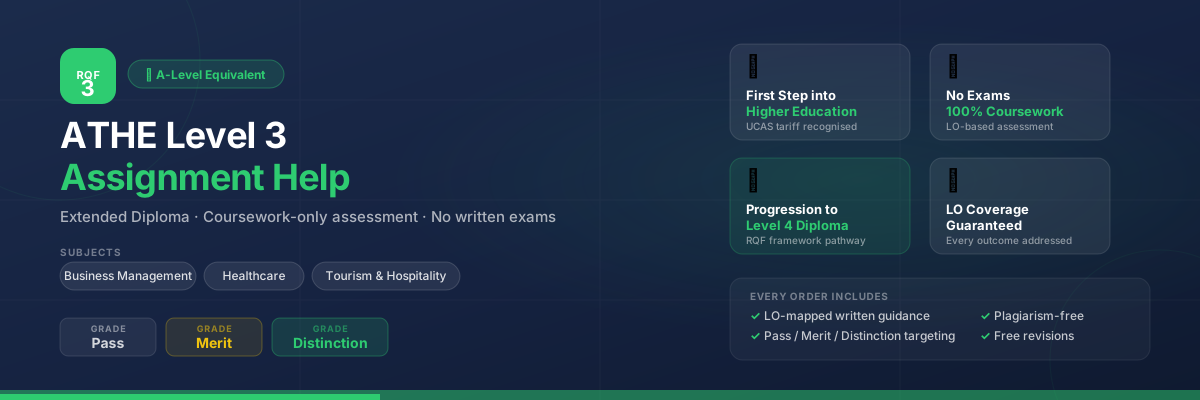
What Is the ATHE Level 3 Extended Diploma?
ATHE (Awards for Training and Higher Education) is an Ofqual-regulated UK awarding body. The Level 3 Extended Diploma sits on the Regulated Qualifications Framework (RQF) at Level 3 and is recognised as equivalent to A-levels for UCAS tariff purposes — it can be used for entry to university or ATHE Level 4. The Extended Diploma is the largest qualification size at Level 3 in the ATHE framework. There are also Certificate and Diploma sizes at Level 3, but the Extended Diploma provides the fullest preparation for Level 4 progression.
The qualification is studied at a registered ATHE centre — a college, training provider, or private provider that holds ATHE centre approval. It is not delivered by universities directly. No examinations are required at any point — all assessment is written coursework submitted to the centre assessor.
Typical learners: school leavers aged 16–19 who have completed GCSEs and are choosing a vocational route rather than traditional A-levels; adult learners returning to education; career changers seeking a formal qualification in Business, Healthcare, or Tourism; individuals pursuing an access-to-higher-education pathway via vocational qualifications.
ATHE Level 3 Subjects: Business Management, Healthcare, and Tourism and Hospitality
Three subject routes are available at ATHE Level 3. Each has distinct unit content, assignment contexts, and typical learner profiles — though all share the same criterion-referenced grading framework and coursework-only assessment method.
Business Management route: Covers foundational business knowledge through units including Business Environment (PESTLE applied at introductory level), Business Resources (human and financial resource management), Marketing Principles (the 4Ps marketing mix applied to a real or hypothetical business), and Introduction to Management (management styles — autocratic, democratic, laissez-faire — and their appropriate application in different business contexts). Suited to learners aiming for careers in business, management, retail, finance, or entrepreneurship, or progressing to ATHE Level 4 Business Management.
Healthcare route (Health and Social Care): Covers the values, practices, and knowledge base of health and social care work. Key units include Health and Social Care Practice (person-centred care, duty of care, safeguarding legislation — Care Act 2014 at introductory level), Human Growth and Development (developmental theories — Piaget's cognitive development stages, Erikson's psychosocial development stages), Communication in Health and Social Care, and Working in Health and Social Care (roles of care workers, professional values, multi-disciplinary teams).
Tourism and Hospitality route: Covers the structure and operation of the tourism and hospitality industry. Key units include Tourism Operations (types of tourism — mass, sustainable/eco, cultural, adventure, medical), UK and Global Tourism (visitor patterns, UNWTO data, impacts of tourism), Hospitality Industry Overview (types of accommodation, food service categories, RevPAR as a key performance metric), and Tourism Research (introductory research methods — questionnaire design, interview approaches, use of secondary data from UNWTO or VisitBritain).
How Are ATHE Level 3 Assignments Assessed?
All ATHE Level 3 assessment is written coursework — no examinations. Each unit has a set of learning outcomes (LOs) defined in the ATHE unit specification. The centre's assessor issues an assignment brief built around these LOs, and learners must address each LO within their written response.
A response that is broadly relevant but does not map explicitly to the LOs will not meet the Pass threshold — even if the writing is well-structured and the subject knowledge is present. LO mapping is the single most important structural skill at Level 3.
Analytical depth at Level 3: assignments are expected to be descriptive and explanatory at Pass level, moving to analytical explanation with applied examples at Merit, and to evaluative reasoning with recommendations at Distinction. Typical Level 3 unit assignments range from 1,000 to 2,500 words. Learners must confirm their centre's specific word count guidance — ATHE does not prescribe a single word count across all units.
ATHE Level 3 Grading Criteria: Pass, Merit, and Distinction
Pass: All learning outcomes addressed with sufficient knowledge and understanding. The response covers the required content correctly and coherently. No significant gaps in LO coverage. Pass at Level 3 means the learner has demonstrated that they understand the topic and can communicate that understanding in writing.
Merit: All LOs met plus Merit descriptors. At Level 3, Merit requires coherent explanation supported by relevant examples — not just describing a concept but explaining how it operates in a specific context. For example, in a Business Environment assignment: a Pass response describes what PESTLE stands for and lists relevant factors. A Merit response explains how a specific PESTLE factor — for example, a change in minimum wage legislation — affects a named business's costs, staffing decisions, and pricing strategy.
Distinction: All LOs and Merit descriptors met plus Distinction descriptors. At Level 3, Distinction requires evaluation — weighing the relative importance, strengths, or limitations of factors, approaches, or options — and recommendations with justification. For example, in a Management Styles unit: a Pass response describes autocratic, democratic, and laissez-faire management. A Merit response explains which style is most appropriate for a named business context. A Distinction response evaluates the limitations of each style in that context and makes a specific, justified recommendation about which approach the manager should adopt and under what conditions.
Harvard referencing is required at all grade levels at Level 3. At Level 3, the standard is introductory — correct in-text citation (author, date) and a reference list.
Common Assignment Types in ATHE Level 3 Courses
Business reports: The most common assignment format in the Business Management route. A business report has a defined structure — title page, introduction, main body with headed sections addressing each LO, conclusion, and references. Level 3 business reports typically use PESTLE, SWOT, or the 4Ps marketing mix as the analytical framework.
Case study analysis: Used across all three routes. The learner is given a scenario — a business facing a challenge, a care setting with a safeguarding issue, a tourism destination managing overtourism — and must analyse it using relevant theory or factual knowledge. At Distinction level, case study responses include a recommended course of action with justification.
Reflective accounts: Common in the Healthcare route. A reflective account asks the learner to describe an experience or scenario, explain what happened and why, analyse what was learned, and consider how they would act differently in the future. Gibbs' Reflective Cycle (1988) is commonly used at Level 3 as a structural framework.
Research assignments: Common in the Tourism route. Learners gather and present data from secondary sources (UNWTO, VisitBritain, ONS tourism statistics) or conduct simple primary research. At Distinction level, the learner evaluates the reliability of their data and the limitations of their research approach.
Progressing from ATHE Level 3 to Level 4
ATHE Level 3 Extended Diploma is the standard entry qualification for ATHE Level 4. The shift from Level 3 to Level 4 is the most significant analytical step in the ATHE qualification pathway. At Level 4, assignments require genuine analytical reasoning — not just applying a theory to a context (Merit at Level 3) but evaluating its limitations, comparing it to alternative frameworks, and drawing evidence-based conclusions. The descriptive-explanatory register of Level 3 is insufficient at Level 4 even for Pass. Harvard referencing also becomes more rigorously assessed from Level 4 onwards.
Achieving a Distinction at Level 3 is the strongest preparation for Level 4 success — a learner who has developed evaluative reasoning at Level 3 will find the transition to Level 4 analytical standards significantly easier. For dedicated Level 4 support: ATHE Level 4 assignment help.
Harvard Referencing at ATHE Level 3
Harvard referencing is required at ATHE Level 3. At Level 3, the core requirement is: in-text citation in author-date format and a corresponding reference list at the end of the assignment, ordered alphabetically by author surname. When the learner refers to an idea, fact, or definition from a source, they include the author's surname and year of publication in brackets: (Kotler, 2016). For direct quotations, a page number is added: (Kotler, 2016, p. 45).
Reference list format for a book at Level 3: Surname, Initial. (Year) Title of Book. Edition. Place of publication: Publisher. For a website: Author/Organisation (Year) Title of webpage. Available at: URL (Accessed: date).
Common errors at Level 3: including a source in the reference list that is not cited in the text; citing "the internet" or "Google" rather than the specific website; using first names instead of surnames in citations; not including a reference list at all. Developing correct referencing habits at this level is essential for Level 4 and beyond.
How Our ATHE Level 3 Assignment Help Service Works
Level 3 students are often encountering formal academic writing for the first time. The service is built around the specific challenges this creates: understanding what LOs actually require, structuring a written response appropriately — business report, case study, reflective account — and calibrating the depth of analysis to the target grade.
All three subject routes are covered: Business Management, Healthcare (Health and Social Care), and Tourism and Hospitality. Writers are familiar with each route's unit content, assignment formats, and typical LO structures. Every assignment is structured to address each specified LO directly — the most common reason Level 3 students receive a Pass when they targeted Merit or Distinction is that their response covers the right subject matter but does not explicitly address the LO as stated.
Grade calibration: learners specify the target grade — Pass, Merit, or Distinction — and the response is calibrated to meet the corresponding descriptors. Harvard referencing is included at the appropriate Level 3 standard throughout. Submit your assignment brief and unit specification using the contact form below to receive tailored Level 3 guidance.
What separates a Level 3 student who achieves Distinction from one who achieves Pass — and how does writing for a grade actually work when there are no exams? The supplementary sections below cover the Level 4 transition and the BTEC comparison that many Level 3 students research before choosing or continuing their qualification route.
ATHE Level 3 and What Comes Next: The Level 4 Pathway
After completing the ATHE Level 3 Extended Diploma, the most direct progression route is ATHE Level 4. At Level 4, the analytical register shifts decisively — from descriptive-explanatory writing to genuinely analytical work. Level 4 students must evaluate theories and frameworks, not just apply them. They must compare competing models, draw evidence-based conclusions, and engage independently with academic literature. The Level 3 pass standard of clearly communicated knowledge is no longer sufficient at Level 4 even for Pass.
Learners who achieved Merit or Distinction at Level 3 — particularly those who developed structured assignment writing and LO mapping skills — are better positioned for Level 4 success. For comprehensive guidance on what Level 4 requires: ATHE assignment help | ATHE Level 4 assignment help.
How Does ATHE Level 3 Compare to BTEC Level 3?
Both ATHE Level 3 and BTEC Level 3 (Pearson BTEC) sit at RQF Level 3 and are Ofqual-regulated. Both are equivalent to A-levels for UCAS tariff purposes and assessed primarily by coursework. Key differences: BTEC is significantly more widely recognised among UK universities and employers due to its longer history and greater market presence. ATHE Level 3 is used primarily at specialist colleges and training providers. Following 2020 reforms, some BTEC pathways now include externally-assessed units — ATHE Level 3 remains coursework-only throughout. For a learner choosing between the two, the decision typically comes down to which qualification the specific centre offers and which universities or Level 4 routes the learner intends to progress to.
Return to the main overview: ATHE assignment help.
Frequently Asked Questions
What is the difference between a Merit and a Distinction in an ATHE Level 3 assignment?
Merit at ATHE Level 3 requires all learning outcomes to be met alongside coherent explanation with relevant examples and introductory application of theory to a specific context — such as explaining how a PESTLE factor affects a named business. Distinction requires all Merit criteria plus evaluation — weighing the strengths and limitations of factors or approaches — and recommendations with justification. Distinction at Level 3 means demonstrating reasoned judgement: not just applying knowledge to a context but drawing conclusions about what should be done and why.
Do ATHE Level 3 assignments require Harvard referencing?
Harvard referencing is required in ATHE Level 3 assignments. At Level 3, the standard is introductory: in-text citations use author-date format — for example, (Kotler, 2016) — and a reference list is included at the end of the assignment, ordered alphabetically by author surname. For direct quotations, a page number is also included.
What types of assignments are most common in ATHE Level 3 Business Management?
Business report format is the most common assignment type in the ATHE Level 3 Business Management route. Reports typically analyse a named real business or a case study scenario using a specified framework — such as PESTLE for the Business Environment unit or the 4Ps marketing mix for a Marketing Principles unit. At Distinction level, reports include evaluation of the factors analysed and justified recommendations for the business.
How does completing ATHE Level 3 lead to entry to Level 4?
ATHE Level 3 Extended Diploma is the standard entry qualification for ATHE Level 4. Registered ATHE centres offering Level 4 programmes typically accept a completed Level 3 Extended Diploma as meeting their entry requirements. The shift from Level 3 to Level 4 requires a significant increase in analytical depth — Level 4 assignments expect genuine evaluation and comparison of theories rather than introductory application.
Need expert help with your ATHE assignment?
Get Help NowCommon Questions
Is this service specific to ATHE qualifications?
Yes. We specialise exclusively in ATHE (Awards for Training and Higher Education) qualifications. Our writers are selected for their specific knowledge of ATHE units, marking criteria, and grade descriptors — not generic academic writing.
Will my assignment be plagiarism free?
Every assignment is written from scratch and run through Turnitin before delivery. You receive a copy of the originality report alongside your completed work.
How quickly can you complete my assignment?
Standard turnaround is 5–7 days. For urgent orders we offer 24-hour and 48-hour expedited delivery at an additional cost. Contact us to confirm availability for your deadline.
What if I'm not happy with the work?
We offer unlimited free revisions within 14 days of delivery. If we cannot meet your requirements after multiple revisions, we offer a full refund — no questions asked.